 Inquiry

 English
 Français
 Español
- Type:
- Industry News
- Date
- 2025-Dec-25
Industry News
Home / News / Industry News / Baby Safety Gate for Stairs Selection Tips for Different Stair Layouts and Home Structures
The search for a suitable baby safety gate for stairs often hits a practical hurdle: most staircases are not perfectly standard. Walls may be uneven, railings may interrupt the space, or the opening may be unusually wide. Successfully securing these varied layouts requires moving beyond a one-size-fits-all approach and applying targeted strategies for common structural challenges.
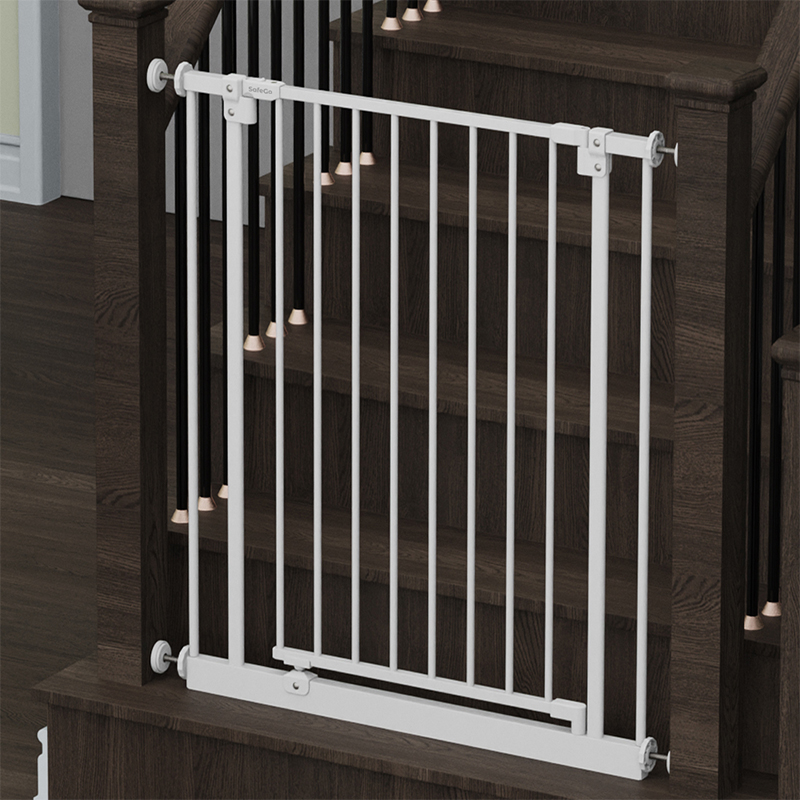
For a staircase with two solid, parallel walls at the opening, the selection process is more straightforward. A hardware-mounted gate with an adjustable width that fits the measured opening is the primary consideration. The main tasks are locating wall studs and following installation instructions precisely to ensure a solid fit.
A very frequent scenario is a staircase where one side ends in a banister or a series of vertical spindles, not a solid wall. A standard gate cannot attach here.
Solution – Banister Installation Kits: These kits are designed to solve this exact problem. They typically include adjustable metal or nylon straps that wrap securely around the banister post, along with a bracket that connects to the gate. This creates a sturdy anchor point that mimics a solid wall. It is important to choose a kit compatible with the gate and to follow the instructions for tightening the straps correctly to prevent slipping or rotation.
Some homes feature staircases with curved walls, unusual angles, or very wide, open openings that lack clear attachment points on both sides.
Solution – Flexible Placement and Custom Kits: For angled or non-parallel walls, gates with a significant width adjustment range and pivoting mounting brackets can sometimes accommodate the angle. For exceptionally wide or irregular openings, the solution may involve using two hardware-mounted gates in series or investigating custom-sized options. In some layouts, it may be more effective to place the gate not directly at the stair opening but in a doorway leading to the stair hall, effectively blocking access to the area altogether.
When the bottom of the stairs opens into a large room without a defining doorway, blocking just the stairs may not be sufficient, as a child could go around.
Solution – Creating a Defined Barrier: This situation often requires a more comprehensive approach. Using a section of extra-wide gate or connecting multiple gate panels with appropriate hardware can create a freestanding barrier that encloses the entire dangerous area, not just the stair treads. This turns the open landing into a secured zone.
Regardless of the layout, the process begins with a thorough assessment. Using a tape measure to note the exact width at several points is crucial. Taking clear photographs of the stair opening from a few angles can be incredibly helpful when consulting product manuals, online resources, or customer support to determine compatibility. Noting the material of the walls and railings (drywall, plaster, wood, metal) will also guide installation choices.
Finding a baby safety gate for stairs for a non-standard layout may require additional research or accessories, but solutions are available. By accurately identifying the specific structural challenge—whether a railing, an unusual angle, or an open plan—and seeking out the corresponding hardware or installation method designed to address it, a safe and secure fit can be achieved for almost any home configuration.




Baby Safety Pen & Pet Gate Factory