
 Inquiry

 English
 Français
 Español
Child-safe Pet Barrier Gate Supplier
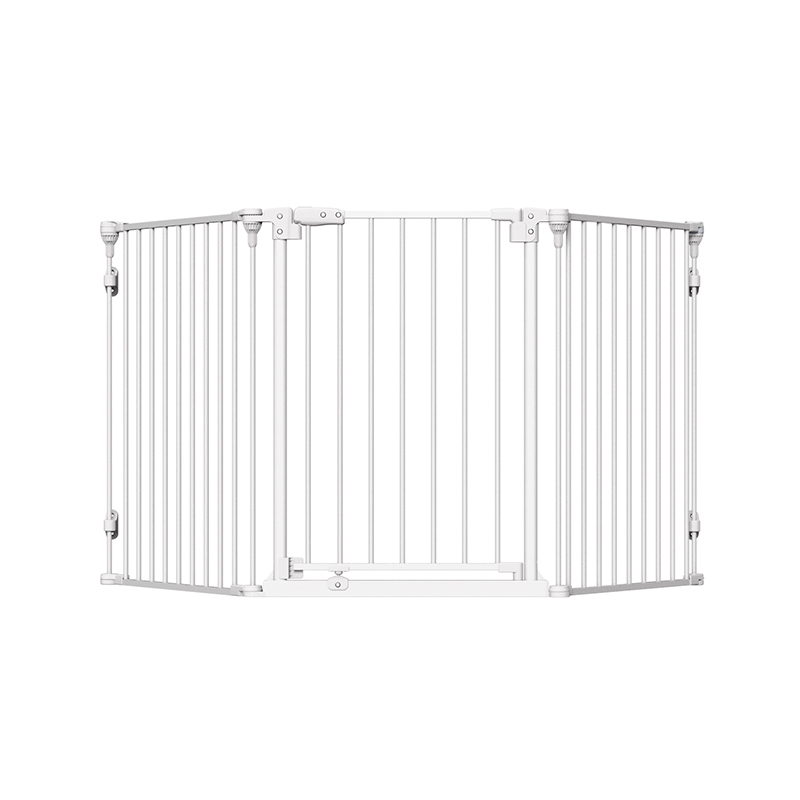
The 3-Panel Barrier Including Gate offers a versatile and secure way to section off wide or irregular spaces in your home. Designed for flexibility, this multi-panel system includes a central walk-through gate for convenient access, making it ideal for open floor plans, fireplace areas, wide doorways, or angled spaces. Each panel is connected by adjustable hinges, allowing the barrier to be configured into various shapes to suit your specific layout needs.
This type of barrier is ideal for parents and pet owners seeking a customizable safety solution. The pressure-mounted or freestanding design allows for quick installation without tools or wall damage, while the sturdy construction ensures reliable containment. The built-in gate typically features one-handed operation and a safety lock system, allowing adults easy passage while keeping children and pets secure.
Many 3-panel barriers are foldable for easy storage and portability, making them suitable for both permanent and temporary use. With a variety of materials and finishes available, these barriers can complement any home décor while delivering functional performance. Whether you're blocking off a room, protecting a fireplace, or creating a play area, the 3-Panel Barrier Including Gate provides adaptable, attractive, and dependable safety.
About Us
Our company is a professional China 3 Panels Barrier Including Gate Manufacturer and Sale 3 Panels Barrier Including Gate Factory. With a modern production base of 50,000 square meters and nearly 300 employees, we are supported by advanced production technology and a rigorous quality management system, and are committed to providing high-quality, cost-effective child safety products. Our products are certified to meet European and American safety standards, and our factory has obtained ISO 9001 and BSCI certifications, ensuring that every product complies with international safety requirements. In addition, we provide flexible OEM/ODM services to meet the diverse needs of global customers. Over the years, we have earned the trust of families worldwide with our excellent products and reliable services.

Latest News
-
Why Does Gate Height Matter More As Children Grow?
Many parents install a safety gate when a child first begins crawling. At that stage, the primary concern is usually acc...
-
Why Do Pet Gates Sometimes Shift After Installation?
A wide pet gates pressure mounted design is often chosen because it can be installed without drilling into walls. For ma...
-
Why Easy-install Pet Fence Become Unstable On Smooth Floors?
Some pet fences feel secure on the first day, then begin shifting slightly across the floor after several weeks of use. ...
-
Portable, Safe, and Stylish Adjustable Baby Playpen
Modern parents often look for baby products that support both convenience and everyday comfort. As living spaces continu...
Contact Us
To receive exclusive offers and the latest deals, enter your email address below.
Industry Knowledge Extension
What Conditions Must a 3-Panel Child-Safe Foldable Pet Barrier Gate Meet Before Market Release?
Bringing a new product like a 3-panel indoor child-safe foldable pet barrier gate to the market is a complex process. Manufacturers must navigate a series of rigorous conditions to ensure the product is not only effective but, more importantly, safe for both children and pets. Before such a gate can be sold to consumers, it must satisfy a multi-faceted set of requirements spanning safety, durability, and regulatory compliance. This process is designed to minimize risks and build consumer trust from the very use.
Adherence to Stringent Safety Standards
The critical condition for market release is the successful passing of established safety standards. These are not mere guidelines but specific, measurable benchmarks that a product must achieve. In the United States, the key standard for these products is set by the ASTM (American Society for Testing and Materials). For gates and enclosures, the relevant standard is ASTM F1004.
To meet this standard, the gate must undergo a series of tests that simulate real-world use and misuse. These tests evaluate the structural integrity of the gate, ensuring it cannot be easily collapsed or knocked over by a child or pet. They also mandate that the gaps between the panels and the overall design do not present an entrapment hazard for a child's head, neck, or limbs. Furthermore, the locking mechanism must be secure enough to prevent a young child from opening it, yet operable by an adult without excessive force. A product that meets these standards can earn certification from independent bodies like the Juvenile Products Manufacturers Association (JPMA), providing a recognizable seal of approval for safety-conscious parents.
Rigorous Material and Durability Testing
Before a gate is cleared for sale, its materials and construction must be proven to withstand the demands of daily use. This involves a battery of tests that go beyond basic safety to ensure long-term reliability. The foldable hinges, for instance, are subjected to thousands of open-and-close cycles to ensure they will not break or become loose over time. The panels and locking mechanisms are tested for impact resistance, verifying they can withstand the pressure of a child leaning against them or a pet bumping into them without failing.
Manufacturers must also verify that all materials used are non-toxic. This is crucial because young children often explore with their mouths. The finishes, paints, plastics, and metals must be free from harmful levels of lead, phthalates, and other heavy metals. This is often verified through laboratory analysis, ensuring compliance with regulations like the Consumer Product Safety Improvement Act (CPSIA). Additionally, the stability of the gate in its unfolded, in-use position is critically assessed. For a 3-panel design, this means ensuring it does not easily "scissor" or collapse under pressure, creating a pinching hazard or failing as a barrier.
Compliance with Legal and Marketing Regulations
Finally, a product cannot be released without full compliance with legal and labeling requirements. This layer of conditions governs how the product is presented and sold to the public. The manufacturer must ensure that all claims made on the packaging and in marketing materials are accurate and substantiated. For example, if the gate is marketed as "extra-wide," its dimensions must clearly support that claim. If it is labeled "for pets and children," it must have passed the relevant safety tests for both use cases.
The product's labeling must include clear and concise instructions for installation and use. Warnings must be prominent, indicating crucial information such as the appropriate age range for children, the fact that the gate should not be used at the top of stairs unless it is hardware-mounted, and the recommended weight or pressure. Furthermore, the packaging itself must include identifying information like the manufacturer's name, location, and the date and location of production. This traceability is essential for quality control and for managing any potential recalls efficiently. Only after all these legal, safety, and durability conditions are satisfactorily met can the gate proceed to be packaged, shipped, and sold to families.



Hangzhou Yiyuan Household Products Co., Ltd.
Product Center
Contact Us
- +86-15268686909
- [email protected]
- Room 1303, Tianyue Times Building, No. 750 Fengqing Road, Gongshu District, Hangzhou, Zhejiang, China
Copyright © 2025 Hangzhou Yiyuan Household Products Co., Ltd. All Rights Reserved.

3 Panel Indoor Foldable Pet Gate Supplier