
 Inquiry

 English
 Français
 Español
- Type:
- Industry News
- Date
- 2026-Jun-19
Industry News
Why Does Gate Height Matter More As Children Grow?
Many parents install a safety gate when a child first begins crawling. At that stage, the primary concern is usually access—keeping children away from stairs, kitchens, or other areas that require supervision.
Months later, however, the challenge often changes.
A child who once stayed close to the floor begins standing, reaching, pulling, and exploring in entirely new ways. This is when many families start paying closer attention to a pressure fit extra tall safety gate and the role height plays in everyday safety.
Interestingly, the conversation is not always about preventing passage through the opening. Sometimes it is about managing what happens above the gate.
Curiosity Develops Faster Than Expected
Parents often notice the same pattern.
One week, a child is simply touching nearby furniture. A few weeks later, that same child is pulling up, stretching toward handles, and investigating anything within reach.
Because of this, a pressure fit extra tall safety gate is frequently viewed differently from a standard barrier. The additional height changes how easily a child can interact with the upper portion of the gate while exploring their surroundings.
The difference may seem minor when the gate is first installed.
As children grow, it often becomes more noticeable.
Families Tend To Keep Gates Longer Than Planned
Many safety products are purchased with a specific stage of development in mind.
In practice, families often continue using them longer than originally expected.
A pressure fit extra tall safety gate installed for a crawling infant may remain in place throughout the toddler years because household routines evolve more slowly than developmental milestones.
Parents adapt to the gate. Children become accustomed to seeing it. Certain areas of the home continue requiring separation regardless of age.
As a result, long-term daily use becomes just as important as the initial installation.
Pets Can Change The Equation
One reason some households choose a pressure fit extra tall safety gate is that children are not the only ones moving through the home.
Dogs and other pets create additional traffic patterns that influence how barriers are used. A gate may need to separate pets from children, protect feeding areas, or establish boundaries during certain parts of the day.
Interestingly, families often discover that managing interactions between children and pets becomes part of the gate's purpose.
The product may have been purchased for one reason, yet everyday use expands its role.
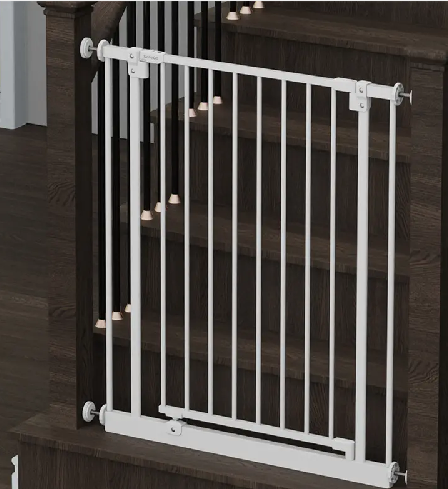
Placement Often Matters More Than The Gate Itself
Walk through different homes and you will notice that identical gates can function very differently depending on where they are installed.
A pressure fit extra tall safety gate positioned near a staircase experiences different usage patterns than one placed between living areas. Some gates are opened frequently throughout the day, while others remain closed for extended periods.
The surrounding environment influences how people interact with the gate just as much as the gate's design.
This is one reason installation planning often begins with household traffic flow rather than product specifications.
Daily Habits Reveal What Works
After a few months, most families stop thinking about the gate itself.
Instead, they notice how naturally it fits into everyday routines. Parents carry laundry through the opening. Children encounter the barrier as part of their normal environment. Pets learn where they can and cannot go.
A pressure fit extra tall safety gate becomes successful when it quietly supports those routines without constantly demanding attention.
That is why experienced parents often evaluate safety products based on long-term practicality rather than first impressions alone.
The interesting thing about gate height is that its importance tends to increase gradually.
Not because the gate changes, but because the people using the home do.
Related products



Hangzhou Yiyuan Household Products Co., Ltd.
Product Center
Contact Us
- +86-15268686909
- [email protected]
- Room 1303, Tianyue Times Building, No. 750 Fengqing Road, Gongshu District, Hangzhou, Zhejiang, China
Copyright © 2025 Hangzhou Yiyuan Household Products Co., Ltd. All Rights Reserved.

Baby Safety Pen & Pet Gate Factory