
 Inquiry

 English
 Français
 Español
- Type:
- Industry News
- Date
- 2026-Jun-26
Industry News
Why Do Outdoor Gates Behave Differently Throughout The Year?
A swinging outdoor dog gate may seem like a simple product at first glance. It opens, closes, and helps define where pets can safely move.
Yet homeowners who use the same gate through multiple seasons often notice something interesting.
The gate can feel slightly different at different times of the year.
It may swing more freely during one season and close differently during another. Sometimes the change is subtle enough that people barely notice it until they compare how the gate behaved several months earlier.
In many cases, the gate has not changed nearly as much as the environment around it.
Outdoor Installations Never Stay Exactly The Same
Unlike indoor barriers, a swinging outdoor dog gate operates in conditions that are constantly changing.
Rain, sunlight, temperature shifts, wind, and ground movement all become part of the gate's daily environment. None of these factors may create an immediate problem, but together they gradually influence how the installation behaves over time.
Homeowners sometimes assume a gate should perform exactly the same way every day of the year.
Outdoor structures rarely work that way.
Even small environmental changes can affect alignment, movement, and overall feel.
Ground Movement Is Often Overlooked
When people inspect a swinging outdoor dog gate, they usually look at the gate itself.
The ground beneath it receives much less attention.
However, soil conditions can change significantly throughout the year. Dry periods, heavy rainfall, freezing temperatures, and natural settling may all influence how surrounding structures behave.
These changes are often measured in very small amounts, but gates are surprisingly good at revealing them.
A gate that suddenly feels slightly tighter or looser may simply be reflecting subtle movement elsewhere in the installation.
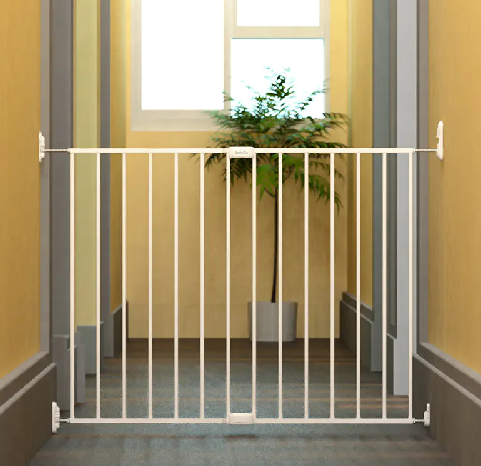
Dogs Create Their Own Wear Patterns
One interesting aspect of a swinging outdoor dog gate is that no two households use it exactly the same way.
Some dogs wait patiently for the gate to open. Others push against it, jump near it, or repeatedly run through the same opening every day.
Over time, these habits create unique wear patterns.
An energetic dog that uses the gate dozens of times daily may influence the installation differently than a pet that only passes through occasionally. The gate often becomes a record of how the animal interacts with its environment.
Actually, experienced pet owners can sometimes identify their dog's favorite route simply by observing the areas that receive the most use.
Weather Exposure Is Not Always Obvious
People often associate weather damage with dramatic events such as storms.
In reality, gradual exposure tends to have a greater influence on outdoor products.
A swinging outdoor dog gate experiences countless cycles of heating, cooling, drying, and moisture exposure throughout its lifespan. These cycles occur so gradually that homeowners rarely notice them from day to day.
Months later, however, small differences may become easier to spot.
The process is usually slow, which is why routine observation often reveals more than occasional inspections.
Everyday Performance Comes From Small Details
Most homeowners judge a swinging outdoor dog gate based on a simple question: does it work smoothly?
What makes that smooth operation possible is often a combination of factors that receive little attention during installation. Environmental conditions, pet behavior, ground stability, and daily usage patterns all contribute to long-term performance.
The gate itself may appear unchanged.
Yet its surroundings are constantly evolving.
That is why outdoor gates often tell a larger story than simply whether a pet can pass through. They quietly reflect seasonal changes, household routines, and years of interaction between animals and the spaces they use every day.
Related products



Hangzhou Yiyuan Household Products Co., Ltd.
Product Center
Contact Us
- +86-15268686909
- [email protected]
- Room 1303, Tianyue Times Building, No. 750 Fengqing Road, Gongshu District, Hangzhou, Zhejiang, China
Copyright © 2025 Hangzhou Yiyuan Household Products Co., Ltd. All Rights Reserved.

Baby Safety Pen & Pet Gate Factory