
 Inquiry

 English
 Français
 Español
- Type:
- Industry News
- Date
- 2026-Jul-24
Industry News
Is Extra Tall Pressure Fit Gate Suitable For Wide Doorways?
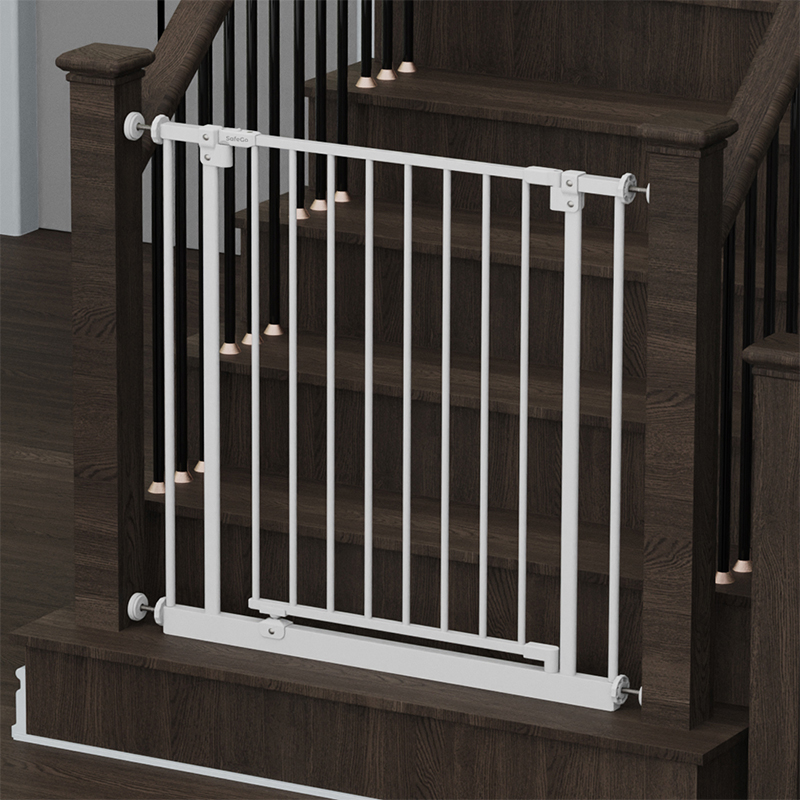
Retailers stocking baby safety gates field a recurring question from customers measuring an unusually wide doorway or open-concept hallway: does a taller barrier still fit securely once the width extends beyond the standard 29- to 36-inch range typical gates ship with? Manufacturers answering that question point buyers toward an extra tall pressure fit gate paired with a matching extension kit, though the fit involves more engineering detail than simply bolting on extra panels.
Extension Kit Compatibility
Width extensions attach to the main gate frame through a connector joint, and that joint needs to hold the same pressure rating as the primary mounting cups once the combined assembly spans a wider opening. An extra tall pressure fit gate extended past its base width redistributes lateral force differently than the unextended frame, since the extension panel introduces an additional joint where flex could otherwise develop under repeated pressure from a leaning child or pet.
Factories designing extension kits for a taller frame reinforce the connector joint with a metal sleeve rather than relying on plastic clips alone, a detail that matters more on taller gates because the increased height amplifies wobble introduced at a weak connection point. Buyers combining height and width requirements should confirm the specific extra tall pressure fit gate model they select carries a rated maximum extended width, since not every base frame supports the same extension range.
Doorway Frame Material And Mounting Depth
Mounting depth at the pressure cups depends partly on the doorway frame material, since a hollow-core door frame compresses differently under pressure than a solid wood or masonry surface. An extra tall pressure fit gate installed against a hollow-core frame needs cup contact spread across a wider surface area to avoid concentrated pressure denting the frame material, while installation against masonry or brick generally tolerates a smaller contact patch without the same risk.
|
Doorway Width |
Frame Material |
Mounting Recommendation |
|
Under 36 inches |
Wood or hollow-core |
Standard cup, no extension |
|
36–48 inches |
Wood or masonry |
Single extension panel |
|
48–60 inches |
Masonry preferred |
Double extension, sleeve-reinforced joint |
|
Over 60 inches |
Masonry or reinforced frame |
Hardware-mounted alternative recommended |
Walk-Through Design At Extended Width
A walk-through gate design stretched across a wider opening places more stress on the door hinge side than the fixed side, since the swinging panel and its hardware still need to operate smoothly regardless of how far the fixed extension panels stretch the overall assembly. Engineers testing extended-width taller gates check hinge alignment after extension panels attach, confirming the door still swings freely and the auto-close mechanism still engages the latch correctly once the added width shifts the panel's center of gravity slightly.
Buyers installing an extra tall pressure fit gate across a very wide opening sometimes discover pressure-fit mounting alone is not adequate once the width exceeds a certain threshold, at which point suppliers generally recommend switching to a hardware-mounted gate that screws directly into the wall studs rather than relying on spring tension across an unusually wide span.
Safety Margin And Testing At Maximum Width
Compliance testing for extended-width configurations covers the assembly at its maximum rated width rather than only the base frame, since a manufacturer claiming a wide-doorway extension range needs test data confirming the fully extended assembly still meets impact and static load requirements. An extra tall pressure fit gate rated for a specific maximum width without corresponding test data at that width leaves buyers uncertain whether the extended configuration performs to the same standard as the base unit.
Choosing Between Pressure Fit And Hardware Mounted Options
Households with doorways near the upper end of the extension range benefit from weighing a pressure-mounted gate against a hardware-mounted alternative before purchase, since pressure-fit tension naturally has practical limits that hardware mounting does not share. An extra tall pressure fit gate remains a strong fit for moderate width extensions where removability matters, such as rental properties where drilling into a wall frame is not an option, while permanent installations at the top of the width range often shift toward hardware mounting for a more secure long-term barrier.
Related products



Hangzhou Yiyuan Household Products Co., Ltd.
Product Center
Contact Us
- +86-15268686909
- [email protected]
- Room 1303, Tianyue Times Building, No. 750 Fengqing Road, Gongshu District, Hangzhou, Zhejiang, China
Copyright © 2025 Hangzhou Yiyuan Household Products Co., Ltd. All Rights Reserved.

Baby Safety Pen & Pet Gate Factory