
 Inquiry

 English
 Français
 Español
- Type:
- Industry News
- Date
- 2026-Jul-10
Industry News
What Makes Extra Tall Pressure Fit Gate Safer For Stairs?
Parents shopping for stair barriers around large dogs or climbing toddlers keep running into the same limitation with standard-height gates: a determined child or an athletic pet clears a 30-inch barrier without much effort. That gap in the market is driving buyers browsing baby safety catalogs to increasingly search for an extra tall pressure fit gate rated well above standard height before adding a barrier to their cart.
Height Standards And Climbing Prevention
Standard pressure-mounted gates typically top out around 29 to 31 inches, a height that works for infants but falls short once a toddler starts using furniture nearby as a step stool. An extra tall pressure fit gate built to 36 inches or higher removes that foothold advantage, since the barrier sits above the reach a climbing child is able to generate even with a boost from a nearby chair or low shelf. Product engineers testing gate height against child climbing behavior note that the additional inches matter less for infants and more for the eighteen-month to three-year range, when climbing attempts reach their peak.
Bar spacing on a taller gate also needs review separately from height, since a wider gate frame sometimes tempts manufacturers to widen bar spacing to save material. An extra tall pressure fit gate that keeps bar spacing under the standard safety threshold while adding height avoids creating a new hazard — a foothold between bars — while solving the original climbing problem the extra height was meant to address.
Mounting Tension And Wall Protection
Pressure-fit mounting relies on spring-loaded cups pressing against opposing door frames or walls, and a taller gate places more leverage on those mounting points than a standard-height unit covering the same doorway width. Manufacturers building a pressure-mounted gate at extra-tall dimensions typically reinforce the mounting cup diameter and add a secondary locking indicator so installers are able to confirm tension reaches the rated level before relying on the barrier around stairs.
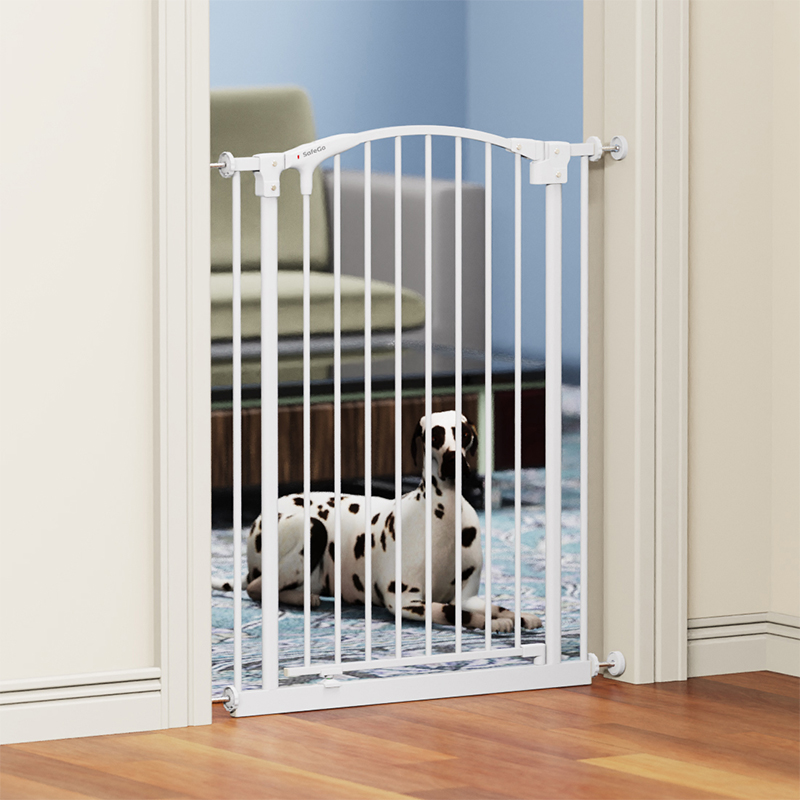
Wall protection matters more at greater height too, since the mounting cups on an extra tall pressure fit gate distribute force across a taller contact zone, which risks denting painted drywall if the cup surface lacks adequate rubberized padding. Factories supplying these gates to retail buyers now include wider protective pads as standard rather than as an optional accessory, responding to complaints about wall marking that surfaced once gate height increased beyond the older standard range.
Walk-Through Door Mechanisms
A taller gate frame changes the engineering behind the walk-through door hinge, since the door panel on an extra tall pressure fit gate carries more weight and swings through a larger arc than a standard-height door panel. Auto-close hinges need stronger spring tension calibrated to the added panel weight, otherwise the door swings shut too slowly to count as reliably self-closing during daily use.
|
Gate Height Range |
Typical Use Case |
Mounting Consideration |
|
29–31 inches |
Standard doorway, infant stage |
Standard cup diameter |
|
32–35 inches |
Wide doorway, toddler stage |
Reinforced cup, tension indicator |
|
36 inches and above |
Stairway, pet and toddler combined |
Reinforced cup, wider wall pads |
Compliance Testing For Taller Frames
Safety certification testing for a walk-through gate covers static load, dynamic impact, and locking mechanism strength, and a taller frame changes how force distributes across the barrier during impact testing. An extra tall pressure fit gate submitted for safety gate compliance testing goes through the same impact protocol as a standard-height unit, but engineers pay closer attention to frame flex at the top rail, since a taller frame under lateral force behaves differently than a shorter, stiffer frame covering the same width.
Factories producing these gates for export markets run torque testing on the mounting cup threading before shipment, confirming the cup reaches rated pressure without stripping the threading — a failure mode more likely on taller gates given the added leverage at the mounting points during daily opening and closing.
Doorway And Width Compatibility
Buyers pairing height with width need to confirm an extra tall pressure fit gate ships with an extension kit compatible with wider doorway openings, since many households combine the tall-frame requirement with an unusually wide stairway or hallway opening. Extension panels added to a taller frame require matching reinforcement at the connection points, otherwise the extended sections introduce flex that a standard-width taller gate would not show under the same pressure-fit tension.
Related products



Hangzhou Yiyuan Household Products Co., Ltd.
Product Center
Contact Us
- +86-15268686909
- [email protected]
- Room 1303, Tianyue Times Building, No. 750 Fengqing Road, Gongshu District, Hangzhou, Zhejiang, China
Copyright © 2025 Hangzhou Yiyuan Household Products Co., Ltd. All Rights Reserved.

Baby Safety Pen & Pet Gate Factory