
 Inquiry

 English
 Français
 Español
- Type:
- Industry News
- Date
- 2025-Oct-14
Industry News
What Are the Pros and Cons of a No-Drill Pet Stair Gate?
Pet stair gates are common in homes where owners want to keep their animals safe and prevent them from entering restricted areas. Among the different types available, the no-drill pet stair gate—often called a pressure-mounted gate—has become a popular choice because of its simple setup and wall-friendly design. However, like any product, it comes with both advantages and disadvantages.
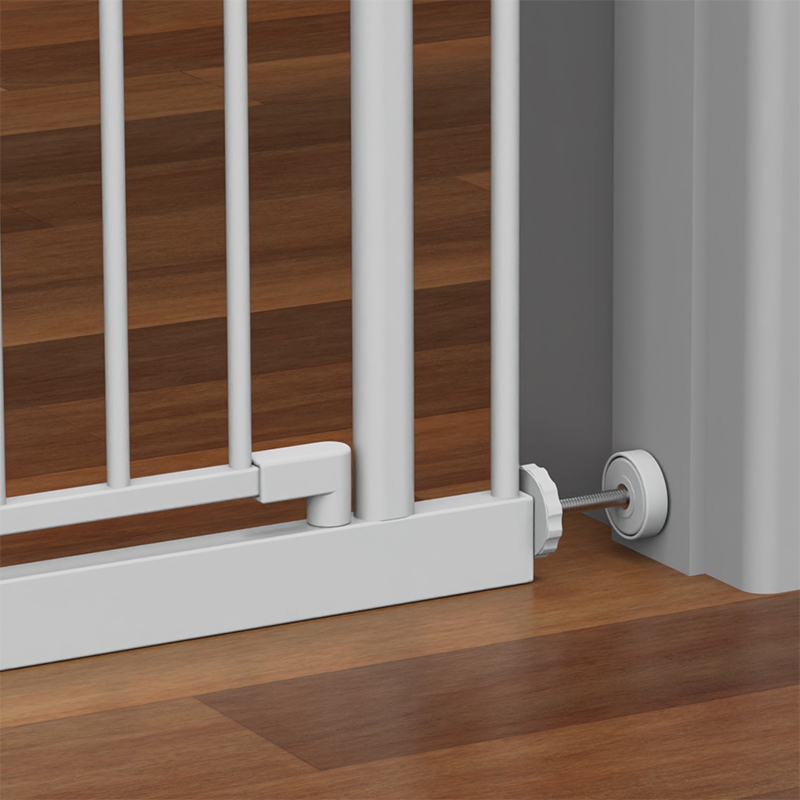
1. What Are the Benefits of a No-Drill Pet Stair Gate?
A no-drill pet stair gate offers several clear advantages, mainly centered around convenience, flexibility, and preservation of home interiors.
a. Easy Installation:
The primary benefit is the simplicity of setup. Since it relies on adjustable pressure points instead of screws or anchors, it can be installed quickly without tools. This makes it especially useful for renters or anyone who prefers not to damage walls or banisters.
b. Wall Protection:
Unlike traditional gates that require drilling holes, a no-drill model uses rubber or silicone end caps to grip walls securely. This prevents marks, scratches, or permanent damage, allowing for easy removal when no longer needed.
c. Portability and Flexibility:
The gate can be easily relocated to different rooms or doorways, depending on where it’s needed more. Families with both children and pets can use the same gate in multiple areas—like between the kitchen and living room or at the bottom of the stairs—without reinstalling hardware.
d. Quick Removal:
When guests visit or when the space needs to be opened, the gate can be removed in minutes and stored away conveniently. This adaptability suits households that frequently rearrange their living spaces or travel with pets.
e. Affordable and Widely Available:
Pressure-mounted gates are generally less expensive than hardware-mounted versions, making them a cost-effective safety solution. They are also widely available in different sizes, colors, and materials to match home decor.
The no-drill pet stair gate provides a balance between safety and practicality. Its non-invasive installation and easy adjustability make it an choice for everyday household use, especially where temporary or flexible barriers are needed.
2. What Are the Disadvantages of a Stair Gate without Drilling?
While a no-drill pet stair gate is convenient, it is not without limitations. Understanding these potential drawbacks helps ensure that users choose the right model for their specific space and pet type.
a. Reduced Stability:
Because these gates rely solely on wall pressure rather than fixed screws, they may shift or loosen over time—especially if pets push against them. This makes them less suitable for large or energetic animals that might jump or lean heavily on the gate. Regular adjustments are often required to keep them firmly in place.
b. Not Ideal for All Stair Locations:
One of the main disadvantages is that no-drill gates are generally not recommended for the top of staircases. A hardware-mounted gate is safer in that position because it is permanently anchored, reducing the risk of the gate dislodging and causing falls.
c. Limited Width and Fit:
While some no-drill gates offer extensions, their adjustable width has limits. Very wide staircases or irregular wall surfaces may not accommodate a pressure-mounted design effectively. In such cases, gaps or uneven pressure could compromise stability.
d. Surface Sensitivity:
Although marketed as “no damage,” using a gate on delicate surfaces such as soft paint, thin drywall, or wallpaper can still leave marks over time. Continuous pressure or movement may cause minor dents or discoloration, especially if the gate is repositioned frequently.
e. Less Permanent Solution:
A no-drill gate works better for temporary use or flexible setups. However, for households that need a long-term barrier—such as with multiple pets or children—a hardware-mounted model may provide better reliability.
Related products



Hangzhou Yiyuan Household Products Co., Ltd.
Product Center
Contact Us
- +86-15268686909
- [email protected]
- Room 1303, Tianyue Times Building, No. 750 Fengqing Road, Gongshu District, Hangzhou, Zhejiang, China
Copyright © 2025 Hangzhou Yiyuan Household Products Co., Ltd. All Rights Reserved.

Baby Safety Pen & Pet Gate Factory